1909 – 1934
The early days in the Augarten
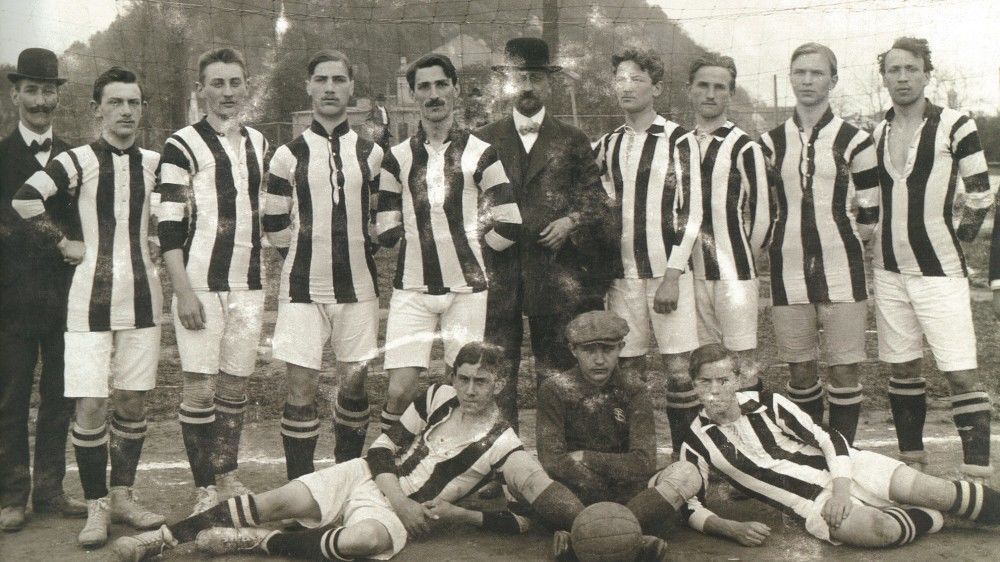
The history of Styria's most successful football club, known today as Sportklub Sturm Graz, begins in Graz's Augarten. In the first decade of the 20th century, the public park on the Mur in the city's sixth district is a paradise for schoolboys and students. Their passion is football – a fashionable sport that finds its way to Graz from England via Prague from around 1893. Even before 1909, a group of talented youngsters gathers around schoolboy Fritz Longin, who owns a leather ball, and student Karl Aßmann. Playing under made-up names such as "Assam del Negro" or "Longino", they are the most successful team in the Augarten park. Soon that is no longer enough, and on 01 May 1909 they come together as a proper football team under the name "Sturm" – probably modelled on the Deutscher Ballspielclub Sturm Prag, which had visited Graz shortly before. Shortly after the club's founding, the Sturm flag with its intertwined "St", still distinctive today, becomes the young club's constant companion. The club colours are black and white.

Sturm at the trotting track
Two more years pass before club philosopher Arnold Schmidt, prompted by the formation of the Deutsch-Alpenländischer Fußballverband (which later becomes the Styrian Football Association), pushes ahead with the club's formal constitution, and on 31 March 1912 the "Grazer Fußballmannschaft Sturm" becomes the "Grazer Fußballklub Sturm". At the beginning of 1913, the DAFV launches the first 2nd division championship, which Sturm win. Matches are no longer played in the Augarten but, as "subtenants", at the GSV ground inside the trotting track, a site behind today's Stadthalle. During the First World War, Sturm are one of the few clubs able to keep up a limited playing schedule. After the end of the war, in November 1918, founding chairman Karl Aßmann announces a fresh start at the Sturm-Café Berghaus by the Radetzkybrücke.
The Gruabn – the first real home
In March 1919, a decade of wandering finally comes to an end when a meadow on the corner of Jakominigürtel and Klosterwiesgasse is leased and becomes the club's first permanent home: the "Sturm-Platz", later known as the "Gruabn", is initially a temporary solution but becomes a long-term home from 1921. The club's name was also to change once more. After several sections are added, the "Fußballklub Sturm" becomes the "Grazer Sportklub Sturm" at the end of 1919. Soon afterwards, the club celebrates its first major success, coming out on top in the first official Styrian championship in the 1920/1921 season.
The first success beyond the region comes in 1934, when Othmar Oroszy, Edi Dellinger, Franz Krusic and co. win the Austrian amateur national title. In the same year, to mark the 25th anniversary under chairman Franz Reistenhofer, the expanded Sturm-Platz is opened with its wooden stand (which still exists today), sponsored among others by Graz businessmen Franz Öhler and the Reininghaus brothers.

1934 – 1949
Sturm in the Nazi era
On the back of these recent successes, Sturm, as a "provincial club", push more and more for the Viennese professional league to open up into a nationwide "Staatsliga". In 1936/37, Sturm narrowly miss out in qualifying for an "expanded" Vienna league against 1. Simmeringer SC and SC Helfort. As a consolation, from 1935 the club competes for the Austrian Cup alongside teams from the capital for the first time.
After Austria's annexation by Hitler's Germany in March 1938, Sturm too are brought into line. During the Nazi era the club comes to terms with those in power: it is run by a party-loyal "club leader", and the youth section has to be run as an HJ (Hitler Youth) team. Yet below the top level, as recent research shows, Sturm remain apolitical and untainted. On the pitch, the club would now at least have the chance to play the Viennese clubs on equal terms in the "Gauliga", but in summer 1938 Grazer Sportklub come out ahead and win promotion there instead. The top Styrian clubs play in the Bezirksmeisterschaft Süd together with Carinthian clubs. From now on, the clubs of what is now the "Ostmark" are eligible for the German Tschammerpokal. In 1940 Sturm make headlines there: Hans Gmeindl, Hans Schabus and co. beat Viennese giants WAC 7:3 and, sensationally, Admira 9:0. Against 1. FC Nürnberg, however, the run ends at the Sturm-Platz with a 1:6 defeat in front of more than 8,000 spectators. Sturm win promotion soon afterwards and play in the "Bereichsklasse" with the Viennese clubs from 1941 to 1943, but all their key players are conscripted into the Wehrmacht. A sporting fiasco follows.
From rebuilding to the Staatsliga
After the end of the war in May 1945, thanks to Josef Plendner, Ernst Oswald and Leopold Krusic, and to good youth work during the war, Sturm quickly assemble an extremely strong team again which – reinforced by Viennese "legionnaires" – wins four state championships and four state cups between 1946 and 1949. Since then, Sturm have held the Styrian records for league titles and cup wins. But it takes until 1948 for Sturm to finally arrive in Austria's top flight. First by reaching the ÖFB Cup final against Austria Wien (0:2 in front of around 38,000 at the Praterstadion), and the following year with the new Staatsliga, of which Sturm are a founding member in its very first season, 1949/50.
1949 – 1966
Sturm in the Staatsliga
In the early Staatsliga years, Ludwig Durek, Max Lamot, Hans Gmeindl and co. establish themselves in mid-table before the club is relegated to the Staatsliga B for the first time in 1953/54. Although Sturm bounce straight back, the club slides into a financial crisis. Financially stronger rivals from the larger industrial cities keep getting stronger, and the Viennese professionals still hold a dominant position. Even so, during this period future national team coach Helmut Senekowitsch becomes Sturm's first Austrian international. But just before the club's 50th anniversary, the Black and Whites are relegated once again.
Bleak years until promotion
For six years Sturm have to make do with the Staatsliga B and then the restructured Regionalliga Mitte. Year after year the Graz side challenge for the title for a long time, only to finish as runners-up or further down. Not until 1963/64 do Heli Wagner, Kurt Reisinger, Burli Wolf and co. achieve the long-awaited promotion. After three yo-yo years, the permanent return to the top flight follows in summer 1966. Since then, Sturm have been the only club outside Vienna to play in the top flight without interruption.
1966 – 1974
Into Europe for the first time
In November 1967, Carinthian Gerd Springer takes charge as coach and introduces more professional structures in Graz. From 1968 to 1970, Sturm establish themselves among the leading sides of the then Nationalliga for the first time, and the team of Damir Grloci, Robert Kaiser, Walter Peintinger, Fredl Murlasits, Heinz Ruß and co. sparks a football fever in Styria rarely seen before. The first international statement comes in the Inter-Cities Fairs Cup in autumn 1970, when top English side Arsenal FC are beaten 1:0 in Graz, and in the return leg Sturm's exit is only sealed by a disputed penalty in stoppage time. Sturm have firmly established themselves in the Nationalliga, even if a fair amount of trouble still lies ahead.
Dramatic relegation battles
The 1972/73 season turns into a year of crisis on the pitch, but new Viennese coach Karl Schlechta (seemingly) secures survival. However, because of foot-and-mouth disease in eastern Austria, games involving direct rivals are only played after the official end of the season, against opponents who seem to lack motivation, and Vienna and SC Eisenstadt overtake the Graz side after all. Sturm lodge a protest – successfully. Thanks to the efforts of coach Schlechta, Hans Gert, Franz Gady and Karl Pühringer at the ÖFB, the league is expanded to 17 clubs.
But by spring 1974 the euphoria over this and over the strong start to the season has evaporated. In April (!) the new ten-team Bundesliga is approved for the following season, and with it a five-year ranking in the fight for survival for the three Styrian clubs. Despite finishing fifth, Sturm fight until the final round for a place in the new Bundesliga and in the meantime even have to fend off politically motivated plans for a merger into an "FC Steiermark". Nevertheless, SK Sturm make it into the new Bundesliga as a founding member.
1974 – 1984
European honours and runners-up
Riding the momentum of qualifying for the new Bundesliga, Sturm under Schlechta reach the second cup final in the club's history (0:3 and 2:0 against champions Wacker Innsbruck). From now on, the Graz side play only at the Bundesstadion Liebenau. In the following season, 1975/76, Mandi Steiner, Hubert Kulmer, Kurt Stendal and co. even reach the quarter-finals of the Cup Winners' Cup, where they go out to Eintracht Frankfurt (0:2, 0:1), having knocked out Szombathelyi Haladás among others along the way. Around 5,000 travelling Sturm fans celebrate reaching the last 16 in neighbouring Hungary – then still behind the Iron Curtain.
After two more excellent seasons under coach Dr. Günther Paulitsch, the team fails to get going in the lawyer's third year and is only pulled out of the bottom of the table by Croatian Otto Barić. In his first full season, 1980/81, coach Barić even completes a full turnaround to the top of the table. With Gernot Jurtin, Božo Bakota, Zvonko Breber and co., the Black and Whites are top at the winter break for the first time and lead the league until the final round. Then, in front of around 23,000 spectators in Graz-Liebenau, their nerve fails. Even so, finishing runners-up is the greatest success in the club's history up to that point.

Return to the Gruabn and UEFA Cup quarter-final
When the Gruabn is brought back into use in autumn 1982, more than 11,000 spectators pack the Sturm-Platz and watch a rampant 4:0 win over SC Eisenstadt. Under Barić's successor Gernot Fraydl, Sturm also challenge near the top for a while and enjoy an unforgettable 1983/84 UEFA Cup campaign. After first knocking out Sportul Studențesc of Bucharest, the Graz side sensationally reach a European quarter-final for the second time by getting past Hellas Verona and Lokomotive Leipzig. There, in Graz-Liebenau, the Black and Whites cancel out the 0:1 first-leg defeat against Nottingham Forest and are just waiting for the deciding penalty shoot-out in extra time when a disputed penalty sends the English side into the semi-finals.
1984 – 1994
Ups and downs despite investment
In 1988, Sturm finish third under Walter Ludescher. With Jürgen Werner, Georg Zellhofer and co., the club gambles on expensive transfers that knock it off course both on the pitch and financially. Even Otto Barić's return cannot prevent this. At the same time, at the end of the 1980s, Hannes Kartnig pushes his way into the club, until he is finally made president at the end of 1992, at the height of the sporting and financial crisis. In addition, in 1992/93, the last year of the play-off system introduced in 1985 before the return to a ten-team league, Sturm slip into the middle play-off after the regular season and face relegation.
Sturm pull back from the brink
In spring 1993, only a few hundred people find their way to the Gruabn. New coach Laco Jurkemik also fails to turn things around at first – quite the opposite. After a derby debacle, only a miracle can save Sturm from dropping into the second tier. New manager Heinz Schilcher and Jurkemik overhaul the squad during the season, putting many young homegrown players into the starting line-up with the second division already in mind, and actually pull off the miracle needed to stay up – by then in front of a full Sturmplatz again.
1994 – 2002
With Osim to the first titles
In summer 1994, Schilcher and Kartnig pull off another miracle. They bring the last coach of the united Yugoslavia national team to Graz – partly because of the war in the former neighbouring country. They also sign Croatian playmaker Ivica Vastić. With other talents such as Mario Haas, Arnold Wetl, Markus Schopp, Gilbert Prilasnig and Günther Neukirchner, Osim introduces a new style of play at the Gruabn: instead of battling, short passing is the new formula, which slowly but surely takes the Black and Whites to the top of Austrian football. In Osim's very first season, 1994/95, Sturm finish runners-up level on points with champions Austria Salzburg, beaten only on goal difference. Just one season later comes the first national title in professional football: Sturm lose out in the decisive head-to-head with Rapid in the final round of the league, but after a 3:1 win over Admira, SK Sturm are crowned cup winners. In 1996/97 the cup triumph is repeated with another win, against Vienna (2:1). At the end of the season, on 31 May 1997, the fans bid farewell to the Gruabn after more than 78 years (3:0 against Rapid). From then on, only the amateur side plays at the Sturmplatz.

The championship trophy finally comes to Graz
Next comes the move to the newly built Arnold-Schwarzenegger-Stadion, today's Merkur Arena, where the first match of the 1997/98 season, the Graz derby, is won 4:0 – the start of a sensational season. Thanks to the goals of the magic triangle Haas – Vastić – Reinmayr, Sturm become champions for the first time in the club's history – with what was then a record lead of 19 points over runners-up Rapid, sealing the title with seven rounds to spare. The double follows in 1998/99 in a dramatic end to the season in which, within a few days, Sturm first beat LASK on penalties in the cup final (1:1 aet, 4:2 on penalties), win the (match-of-the-century) derby in the penultimate round with a stoppage-time goal from Jan-Pieter Martens (2:1) and, as Haas bows out before his move to Strasbourg – for a then record fee of more than 50 million schillings – clinch the title against FC Tirol (3:0).
Storming the Champions League
These successes are surpassed only by three consecutive appearances in the Champions League group stage from 1998/99 to 2000/01. While Sturm pay their dues in Europe's elite competition in the first two seasons, against the likes of Real Madrid, Inter, Olympique de Marseille and Manchester United, in their third campaign they sensationally top their group – ahead of UEFA Cup winners Galatasaray and national champions Rangers FC and AS Monaco. The Black and Whites are among the best 16 teams in Europe and still have a chance of reaching the quarter-finals going into the final matchday of the second group stage.
2002 – 2006
Relegation battle after Osim
But the high does not last. In 2000/01, straight after the Champions League euphoria, the club finishes only fourth in the league and, despite the expensive signings of Charles Amoah and Haas, misses out on a major European competition. A radical and costly rebuild follows, which in 2001/02 brings another runners-up finish and a cup final. But in August 2002 Sturm go out of Champions League qualifying against Maccabi Haifa, and shortly afterwards coach Osim resigns after a 1:3 home defeat to FC Kärnten. His successors Franco Foda and Gilbert Gress cannot build on Osim's success, and in 2003/04 SK Sturm suddenly find themselves fighting relegation. Mischa Petrović first keeps the Black and Whites up in the final round (4:1 against SW Bregenz in front of 15,000 in Liebenau) and then rejuvenates the team – but the financial situation comes to a head once again in the club's history.
Sale of the Gruabn and insolvency filing
For the 2005/06 season, the club is granted a Bundesliga licence only with conditions for the first time, even though Kartnig had previously sold off the lease rights to the Gruabn to the city. Franco Foda gets a second chance as head coach, and by August 2006 it is clear that only an insolvency filing with a compulsory settlement can save the club from its crushing debts. On 23 October 2006 Sturm file for insolvency, and on 02 November Kartnig hands over the presidency after 14 years to club stalwart Hans Fedl.
2006 – 2012
Rescue and resurrection
In late autumn 2006, a group of patrons led by Fedl, Hans Rinner and Christian Jauk takes over and persuades insolvency administrator Dr. Norbert Scherbaum to let the club keep playing. A nail-biting series of negotiations follows, which ends positively thanks to the patrons and the three investors brought in by Jauk – Raiffeisen, Grazer Wechselseitige and Styria Medien AG – with a successful compulsory settlement on 25 January 2007 and a new leadership team around president Rinner and finance director Jauk. In spring 2007, Sturm stay in the league despite a 13-point deduction. And in the 2007/08 season Sturm are top at the winter break once again, finishing fourth in the end – the club has recovered both on the pitch and financially. This is also thanks to the excellent work in the Sturm academy, which during this period develops talents such as Sebastian Prödl, Christoph Leitgeb, Jürgen Säumel, Jakob Jantscher and Daniel Beichler.
25,000 Sturm fans in Klagenfurt and a third league title
The 2008/09 season is all about the anniversary year – the club celebrates its centenary with fourth place and by sensationally reaching the group stage of the newly created UEFA Europa League. Attendances reach their highest levels since 1998. Sturm get back on a sound financial footing: the instalments to the investors are repaid by the end of 2009, and the Messendorf training centre is rebuilt and modernised. With financial security as a foundation, Franco Foda and his team are able to recapture the glory days of the Osim era in 2010. In front of 25,000 Sturm fans at Klagenfurt's Wörthersee-Stadion, a goal from Klemen Lavrić secures the cup against Wiener Neustadt. The first title in eleven years is a reality.
Just one year later, this success is unexpectedly surpassed. In a tight season, Franco Foda's team improves from game to game, especially in the spring, and makes the impossible possible: Sturm Graz win the third league title in the club's history. Just a few weeks after the triumph, however, they go out in the Champions League play-off against Belarusian champions BATE Borisov (1:1 and 0:2). In the Europa League group stage they at least manage one win, but things do not go to plan in the league. As Franco Foda announces his departure in the summer, the club reorganises itself.

2012 – Today
Professional structures for a new era
From 2011, Sportklub Sturm launches a women's football section. In its first years, as a joint team with FC Stattegg, it soon wins promotion to the Bundesliga, where by 2022 it finishes runners-up four times and reaches a cup final. On the men's side, the club structure changes – from now on a commercial and a sporting managing director run the club, at times even with a general manager above them, and with Thomas Tebbich and Günther Kreissl continuity arrives in this area. Only with it does success on the pitch return to the Graz club. Away from day-to-day business, Sturm set up a Legends Club in 2017 and get involved in the citizens' initiative to save the Gruabn, which in 2021 is even placed under heritage protection and has its wooden stand renovated.
David beats Goliath
In a sensational 2017/18 season, the Black and Whites are first top at the winter break, but lose coach Franco Foda, in his third spell in Graz, to the ÖFB. His successor Heiko Vogel changes the style of play, which means that Sturm only really get going after a few weeks of transition under the German. In the cup final on 09 May 2018 they face league heavyweights FC RedBull Salzburg. David-Sturm stand up to Goliath-Salzburg and strike in extra time through golden-goal scorer Stefan Hierländer. It is the Graz side's fifth cup win. Shortly afterwards, SK Sturm also secure second place in the league.
Back in Europe and a cup title
In 2020 – in the middle of the Covid-19 pandemic – Andreas Schicker takes over as sporting director and shortly afterwards appoints Christian Ilzer, at a time of strain both on the pitch and financially. Together, Schicker and Ilzer follow a three-year plan that bears fruit in the very first season: third place and the first guaranteed qualification for a European group stage after a ten-year gap are the result of the hard work. At the start of 2021/22, they even reach the Europa League, and at the end of the season finish league runners-up for the seventh time in the club's history. In the 2022/23 season, Sturm played in the Europa League group stage for the second year in a row and collected eight points. Particularly bitter: they went out of Europe bottom of the group. Never before had a team finished last with eight points. The curious part: group winners Feyenoord had the same number of points. Domestically, however, Sturm had another outstanding season, in which Ilzer's side won the sixth cup title in the club's history with a 2:0 final win over Rapid Wien on 30 April 2023.
A flood of titles
Things went even better in Europe a season later: in 2023/24 the club played European football after the winter break for the first time, finishing 3rd in the UEFA Europa League group stage and then getting through another round. Domestically, a 2:1 win over Rapid in Klagenfurt saw them defend the cup and lift the trophy for the 7th time in total, and in a dramatic finish a 2:0 home win over Austria Klagenfurt brought a 5th league title and the second double in the club's history. Thanks to the league title, the Black and Whites qualified automatically for the first-ever league phase of the UEFA Champions League in 2024/25. There they finished 30th with two wins (both 1:0, against Girona FC and RB Leipzig) at their temporary home stadium in Klagenfurt. Also memorable was the black-and-white exodus of around 6,000 Sturm fans to Dortmund. Despite the departure of most of the sporting leadership, including Andreas Schicker and Christian Ilzer, club legend and new coach Jürgen Säumel defended the title in one of the most thrilling title races in history with a 1:1 draw at home to Wolfsberger AC in the final round. Sturm began 2025/26 in the Champions League qualifying play-off but went out to Norwegian champions FK Bodø/Glimt. In the UEFA Europa League league phase, the Schwoazn face Glasgow Rangers, Red Star Belgrade, Nottingham Forest, SK Brann Bergen, Feyenoord Rotterdam, Celtic Glasgow, FC Midtjylland and Panathinaikos.